
Roof Repair in Orem — 26.2 Roofing Has Your Back
26.2 Roofing delivers licensed roof repair in Orem with same-day response for active leaks and storm damage across all of Utah County. From emergency patching to hail damage and flashing repair — we handle it all with a written scope, matched materials, and a final walkthrough every time.
- Licensed & insured in Utah
- Same-day emergency response
- Written scope of work on every job
- Serving Orem, Provo & Utah County
- Residential & commercial roofing
- Free, no-pressure estimates
What Is Roof Repair in Orem — And What Does the Process Look Like?
26.2 Roofing handles targeted corrective roof repair in Orem — fixing a specific damaged area or system without tearing off the whole roof. This is fundamentally different from a full replacement, and knowing that distinction saves Orem homeowners both time and money. Orem's housing stock spans a diverse mix of roof types, from older asphalt shingles in established neighborhoods to flat membranes on newer townhomes.
The repair process applies across all of them. This section covers what our crew does on-site, which roof types we service, and exactly what you should expect from your first call through the final walkthrough.
How Do Orem Roofers Diagnose and Assess Roof Damage?
Our team starts every roof repair in Orem with a physical inspection of three areas: the roof surface, the attic space, and the interior ceiling below the suspected leak zone. The entry point of a leak is often several feet away from the visible water stain — tracking it requires reading the whole system, not just the surface. We look for damaged or missing shingles, compromised flashing around penetrations like vents, chimneys, and skylights, deteriorated underlayment, soft or spongy decking, and moisture signs in the attic cavity. Orem roofers also watch for Utah-specific damage patterns — granule loss from hail impact and shingle cracking caused by freeze-thaw cycling are two of the most common findings on Utah County roofs.
The inspection output is a written scope of work, not a verbal estimate. You see exactly what gets repaired and why before we touch a single shingle. 26.2 Roofing builds its roof repair process in Orem on this documentation standard because it protects both the homeowner and the quality of the completed work.
What Common Roof Types Does 26.2 Roofing Repair in Utah County?
We repair six primary roof types across Utah County. Our process, materials, and timeline adapt to each one — and knowing your roof type is covered removes one of the biggest hesitations homeowners have before calling.
Asphalt Shingle
The most common roof type in Orem's residential neighborhoods. Standard repair involves shingle removal, underlayment check, and matched-material replacement.
Most Common in OremArchitectural / Dimensional
Two-layer laminated shingles with better wind and impact resistance. Matching these requires sourcing the same product line — we handle that before work begins.
Current Orem StandardFlat Membrane (TPO / EPDM)
Common on Orem townhomes and commercial-adjacent buildings. Membrane repairs use heat-welding (TPO) or adhesive patching (EPDM) — not nail-fastened shingles.
Townhomes & CommercialTile Roof
Found in newer Utah County subdivisions. Tile repair demands careful removal and reinstallation — adjacent tiles crack if handled without the right technique.
Newer SubdivisionsMetal Roof
Standing-seam and corrugated metal panels each require specialized fastening and sealing methods. Metal repair also addresses seam separation from thermal expansion.
Long-Term DurabilityWood Shake
Wood shake repairs require matching grain and thickness carefully. Individual shakes are split and removed without disturbing surrounding courses.
Premium Character HomesThe repair method, material sourcing, and timeline differ by roof type. We identify all three during the on-site assessment before any work is scheduled.
What Can I Expect From Start to Finish With a Roof Repair in Orem?
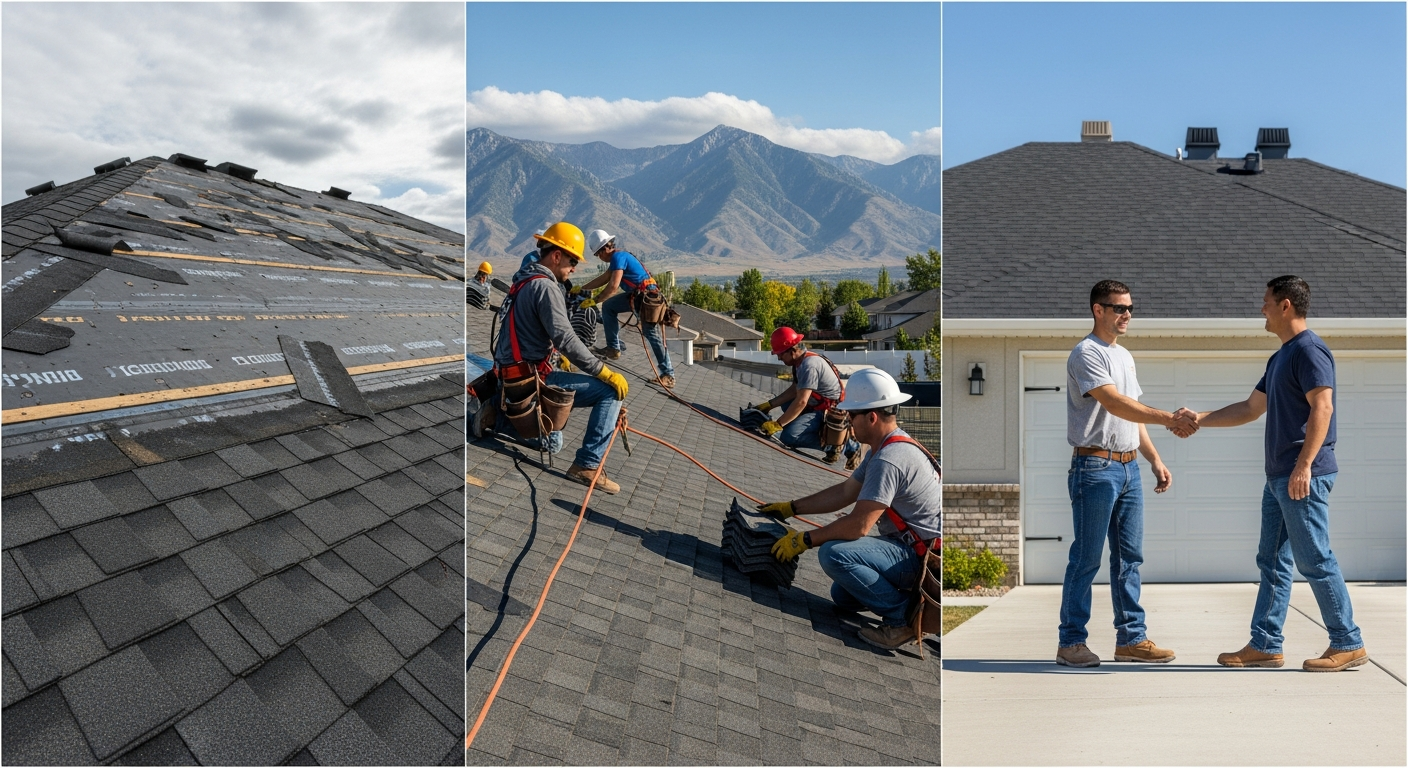
Our roof repair process in Orem runs through five clear stages. No surprises, no ambiguity — just a defined sequence you can follow from the first call to the final handshake.
Same-day or next-day for non-emergency jobs
1–2 hours; roof, attic & interior reviewed
Scope, materials & timeline — in writing
Most standard repairs: 1 day. Larger repairs: 2–3 days
Documentation for warranty & insurance provided
Most repairs require minimal interior access. Normal household activity continues throughout. The final walkthrough gives you paperwork — not just a handshake — so you have documentation for insurance and warranty purposes.
Orem's Climate Is Hard on Roofs — Here's What You're Up Against
Orem sits at approximately 4,770 feet above sea level in Utah County. That creates a roofing environment more demanding than most homeowners realize. Three compounding stressors wear roofs down faster here than in lower-elevation climates: intense ultraviolet radiation, significant annual snowfall averaging 30–40 inches in valley areas, and repeated hail events across the Wasatch Front. This section explains the mechanisms — not to alarm you, but so you understand why Orem roofs degrade on a different schedule and what that means for your repair and maintenance decisions.
Utah County, Wasatch Front
What Are the Hail, Snow Load, and UV Threats to Utah Roofs?
Hail Impact
Utah's Front Range and valley corridors experience hail from late spring through early fall. Hailstones as small as one inch fracture asphalt granules and expose the mat below — damage that's invisible from the ground but clear during an inspection.
Snow Loads
Wet spring snow reaches up to 20 pounds per cubic foot. Utah County building code requires roofs to meet specific ground snow load ratings. Accumulated weight stresses decking, fasteners, and ridge lines — especially on roofs with any existing weaknesses.
UV Radiation
At Orem's elevation, UV radiation measurably exceeds sea-level intensity. This accelerates oxidation of asphalt binders in shingles — causing cracking, curling, and brittleness years earlier than manufacturer warranties typically suggest.
These three threats don't operate in isolation. A roof weakened by UV exposure absorbs hail impact more severely and sheds snow load less efficiently. That's the Orem roofing reality, and it's why our licensed roof repair approach accounts for all three stressors during every assessment.
What Are Ice Dams and How Do They Cause Freeze-Thaw Damage in Utah County?
Our team sees ice dam damage on Utah County roofs every late winter and early spring — and the root cause surprises most homeowners. Heat escaping from a poorly insulated attic warms the roof deck above it. That warmth melts the bottom layer of snow.
The meltwater flows down toward the cold eave overhang, which has no warm air beneath it. At the eave, it refreezes. That ice ridge grows into a dam that prevents subsequent meltwater from draining — so water backs up under the shingles and into the home.
Utah County's temperature swings make this worse: daytime highs above freezing, overnight lows well below. Each freeze-thaw cycle expands and contracts flashing joints, caulked seams, and shingle fastener holes. Repeated cycling opens gaps that allow water in.
Prevention centers on three factors: attic insulation (R-38 to R-60 is commonly recommended for Utah County's climate zones), adequate attic ventilation to equalize roof deck temperature, and ice-and-water shield underlayment installed at eaves. Ice dam damage is often misattributed to a roof failure when the true cause is an attic insulation or ventilation deficiency — a distinction that affects both the repair approach and your insurance claim outcome.
What Seasonal Roof Maintenance Keeps Orem Roofs Ahead of Damage?
🍂 Fall Tasks — Before First Snowfall
- Clear gutters and downspouts of debris to prevent ice dam formation
- Inspect flashing around chimneys, vents, and skylights for separation or cracking
- Check ridge cap shingles for lifting or separation
- Confirm attic ventilation is unobstructed
- Look for granule accumulation in gutters — a sign of accelerated shingle wear
- Re-seal any visible caulked penetration points before freeze cycles begin
🌱 Spring Tasks — After Snowmelt
- Inspect the roof surface for granule loss, lifted shingles, or soft spots indicating deck damage from snow load
- Check gutters for granule accumulation since winter
- Look for daylight visible through the attic — indicates gaps in the deck or ridge
- Inspect flashing for separation caused by winter freeze-thaw cycling
- Schedule a professional inspection if any hail events occurred over winter
- Book any repairs before late summer to benefit from best adhesive curing conditions
Roof Damage We Repair in Orem — From Emergency Leaks to Storm Aftermath
Roof damage in Orem ranges from slow-developing issues like granule loss and flashing separation to sudden failures during storms. We handle four primary damage scenarios: active emergency leaks, hail impact, wind and structural damage, and flat roof membrane failure. Most damage types aren't visible from the ground. A professional assessment is the only reliable way to determine the full scope — and we provide that assessment at no charge.
🚨 Emergency Roof Leak Repair — What to Do Right Now
If water is actively entering your home right now, here's what to do before our crew arrives:
- Move belongings and place containers to collect water. Prioritize electronics and valuables — get them away from the affected area first.
- If you can safely access the attic space, place towels or a bucket near the visible wet spot to slow interior damage. Do not attempt to access the roof during rain or high winds.
- Call us immediately. We use emergency tarping and temporary waterproofing to stop active water intrusion until permanent repair is complete. The cost of emergency response is a fraction of what water damage to ceilings, insulation, and structure will cost if the leak continues.
What qualifies as a roofing emergency: Active interior water intrusion, visible structural sagging, missing shingles exposing decking after a storm, or any situation where delay will cause progressive structural or interior damage.
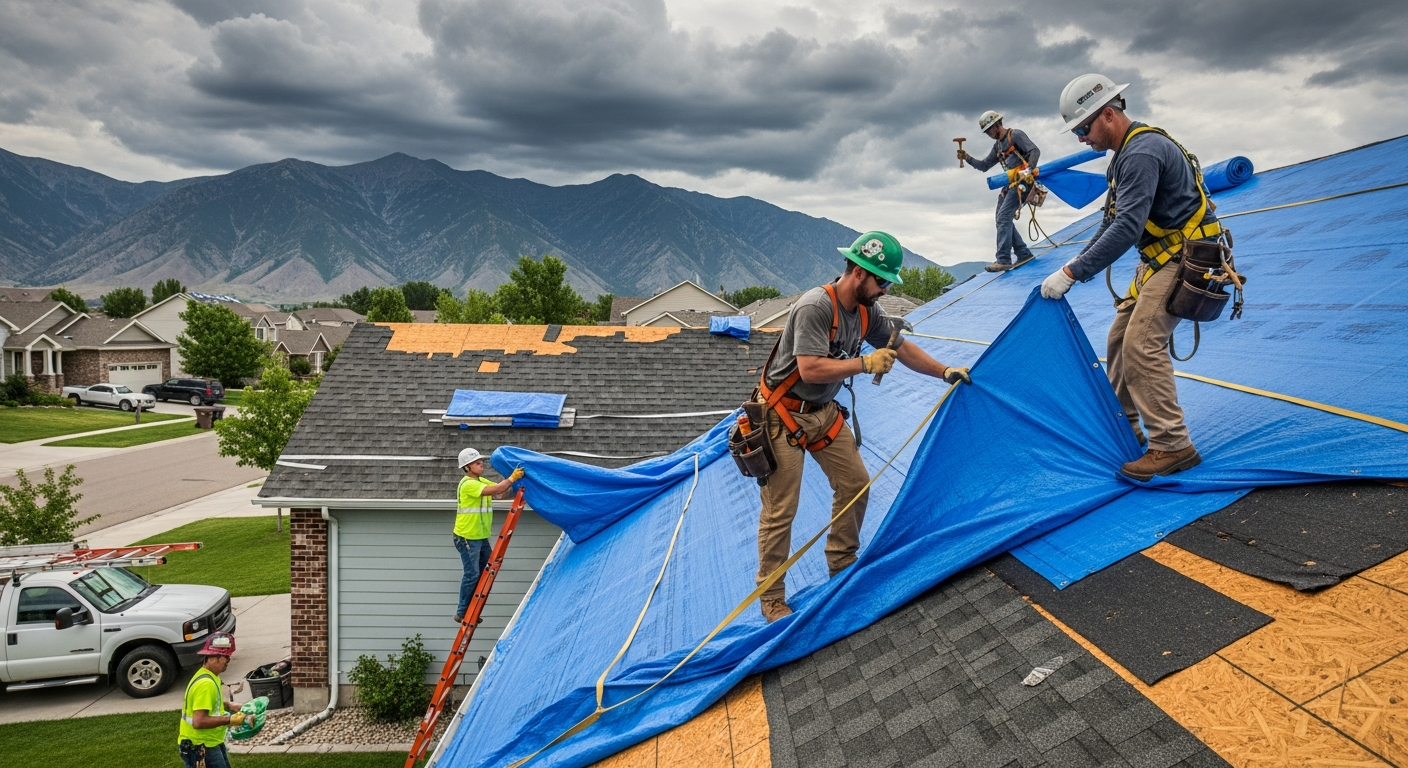
Hail Damage Repair After a Utah Storm
We inspect the full surface, photograph affected areas, and assess whether damage is localized (patch repair) or widespread across multiple squares. Don't wait — Utah's insurance claim window for hail is typically two years from the storm date, and documentation timing matters.
After a major Wasatch Front hail event, out-of-state storm chasers arrive quickly and work fast — with no Utah address, no license you can verify, and no accountability. Call a local contractor first.
Wind, Flashing, and Structural Damage Repair
Utah County canyon-driven winds peel shingles at edges and ridges first. Wind damage repair involves reinstalling lifted shingles and reinforcing fastening at affected zones. Flashing — the metal strips around chimneys, skylights, and pipe boots — is one of the most common leak sources we find in Orem homes.
Decking rot from small ignored leaks is less common but costly when it occurs. The small-leak-becomes-big-problem risk is real — and a written scope catches it before it escalates.
Flat Roof and Membrane Damage
Flat roofs in Orem — most common on commercial buildings and some residential townhomes — use TPO or EPDM membrane systems. Primary failure modes: ponding water when drains clog, seam separation, punctures from debris, and flashing failure at parapet walls.
Membrane repair requires a contractor experienced with these systems. Many shingle-focused roofers lack the equipment for heat-welding TPO or proper adhesive EPDM patching — an incorrect material accelerates the existing failure.
Repair or Replace? How to Know What Your Orem Roof Actually Needs
Many Orem homeowners wonder whether a contractor is recommending a replacement they don't actually need. This section gives you an honest framework for making that call. A reputable contractor should explain exactly which conditions push a roof from repair territory into replacement territory. The answer depends on three variables: the age of the roof, the percentage of surface area affected, and the condition of the underlying deck and structural components.
✓ Repair Is Sufficient When...
- Damage is isolated to a specific slope, flashing zone, or penetration perimeter — not distributed across the whole surface
- The roof is fewer than 15 years old with serviceable shingles in undamaged areas
- The roof deck is structurally sound — no soft spots, rot, or sagging
- Fewer than 25–30% of the total roof surface area shows damage or wear
- Existing shingles can be closely matched so the repair doesn't create a severe aesthetic mismatch
- A professional repair can realistically extend service life by 5–10 years
⚠ Consider Replacement When...
- The roof is at or beyond 20–25 years old — Utah's UV exposure and hail risk shorten lifespans compared to milder climates
- Damage covers more than 30–40% of the total surface — making a partial replacement functionally similar to a full one in labor terms
- The roof deck has widespread moisture damage, soft spots, or delamination
- Two shingle layers already exist — most Utah jurisdictions cap this as the maximum before a tear-off is required
- An adjuster or contractor has documented that the roof doesn't meet current wind or snow load code
- Cumulative repair costs over the last few years are approaching replacement cost
Should You Repair Before Selling Your Home in Orem?
In the Orem and broader Utah County real estate market, buyers routinely request roof inspections during due diligence. A roof cited as "near end of life" or "with active damage" is a common negotiating point that reduces sale price or triggers a seller credit.
Three scenarios to consider:
- Defined, contained problem: A repair removes a material deficiency from the inspection report at a cost significantly below what the buyer's agent will demand as a credit.
- Roof near end of life regardless of visible damage: Buyers and their agents flag age even without visible damage. A replacement may be warranted.
- Relatively new roof with a specific repair need: Document the repair with a written scope and warranty — it becomes a selling asset, not a liability.
We recommend a pre-listing roof inspection so you control the narrative rather than reacting to a buyer's inspector finding something on your closing day.
What Materials Does 26.2 Roofing Use for Repairs in Orem's Climate?
Material selection for a roof repair in Orem is not a one-size-fits-all decision. The climate demands specific performance characteristics that generic or budget materials don't always deliver. The materials used determine how long the repair holds, whether they void the existing roof warranty, how well the repaired area integrates visually, and how the patch performs under Utah's specific combination of UV exposure, hail impact, and freeze-thaw cycling.
What Shingle Options Does 26.2 Roofing Use for Orem Repairs?
3-Tab Shingle
The thinner, flat single-layer option. Still used in repairs to match older roofs originally installed with 3-tab. Lighter weight, lower profile, shorter lifespan — and standard 3-tab wind uplift ratings can be exceeded in canyon-adjacent Orem neighborhoods.
Architectural / Dimensional
The current standard for most Orem residential repairs. Two-layer laminated construction gives better wind and impact resistance — typically rated to 110–130 mph wind. Longer manufacturer warranties than 3-tab. This is what we recommend for most repair work today.
Impact-Resistant (Class 3 / Class 4)
Modified asphalt blend with a reinforced mat. Designed to withstand hail impact without granule loss or mat fracture. Class 4 IR shingles qualify for a discount on some Utah homeowners insurance policies — ask your insurer before selecting materials. This is the right upgrade for Orem's hail exposure.
What Underlayment, Ice and Water Shield, and Flashing Does 26.2 Roofing Use?
We use three non-visible layer systems on every Orem repair where disturbed sections require proper reassembly. Each plays a specific role that shingles alone cannot cover.
Why Does Matching Materials Matter So Much for Your Roof in Orem?
When a partial repair uses shingles that differ in profile, granule color, or manufacturer from the existing roof, the result is a visually obvious patch. In Orem neighborhoods with HOA appearance standards, that can trigger compliance issues on top of the aesthetic problem. Beyond looks, material mismatches create warranty complications — some manufacturer warranties require consistent product lines across the roof to remain valid.
26.2 Roofing establishes the benchmark for thorough, material-matched roof repair in Orem by treating every partial repair as an integration challenge — not just a patch job. Getting this right protects your warranty, your curb appeal, and your HOA standing.
Frequently Asked Questions About Roof Repair in Orem
Real questions Orem homeowners ask before calling. Straight answers below — no fluff.
How Much Does Roof Repair Cost in Orem, Utah?
Industry data shows minor roof repairs in Orem typically run $300–$1,500, and more significant damage ranges from $1,500–$5,000. Your actual cost depends on the extent of the damage, the roofing material involved, and roof accessibility. Utah-specific factors — UV degradation, ice dam damage, and thermal cycling — also affect the scope. The most reliable way to get an accurate number for your situation is a free on-site inspection and detailed written estimate. We don't quote prices before we see the roof.
Does Roof Repair or Replacement in Orem Require a Permit?
Yes. Building permits are required for roof replacement in Orem, and energy code compliance is mandatory for new roofing systems. Permits must be pulled before work begins, and Utah County inspections are required upon completion. A reputable contractor handles the entire permit application and inspection process — you shouldn't need to visit a government office or worry about code compliance yourself.
What Are the Most Common Roofing Problems for Orem Homeowners?
The most common issues we find in Orem are UV degradation, ice dams, thermal cycling damage, and aging subdivision roofs approaching or past their service life. Orem receives an average of 50 inches of snowfall annually. Its position between Utah Lake and the Wasatch Mountains creates weather patterns that stress roofing systems hard. Wind, hail, and heavy rain loosen shingles and flashing, creating leak pathways that worsen over time if ignored.
What Is the Best Roofing Material for Homes in Orem?
Impact-resistant architectural shingles are the most popular choice for Orem homes — they hold up well against moderate hail risk and heavy snowfall. Metal roofing is increasingly popular for its long-term durability and energy efficiency. The right call depends on your budget, home style, and the specific weather conditions your roof faces. A professional consultation with material samples and warranty comparisons gives you the information to decide.
How Quickly Can a Roofer Respond to Emergency Roof Damage in Orem?
We offer same-day emergency response for active leaks and severe storm damage. In most cases, a crew can be on-site within hours to use emergency tarping and complete a damage assessment to stop further water intrusion. When evaluating any contractor, ask them to state their emergency response time explicitly — not just "we're available."
Will a Roofing Contractor Help Me With My Insurance Claim for Storm Damage in Orem?
Many Orem roofing contractors offer insurance claim assistance — documenting the damage thoroughly and communicating with your insurer on your behalf. We support homeowners through the claim process from initial assessment to final approval. Be cautious of any contractor who pressures you to file a claim or makes promises about what your insurance will cover before a proper inspection is done. That's a red flag.
How Do I Know If My Roof Needs Repair or Full Replacement?
Isolated leaks, a few missing shingles, or localized flashing damage can usually be addressed with a targeted repair. Widespread UV degradation, significant storm damage across multiple sections, aging past the 20–25 year mark, or repeated leaks in different areas point toward replacement as the more cost-effective long-term outcome. A professional inspection is the most reliable way to determine which option fits your roof and your budget.
How Do I Spot a Disreputable Roofer in Orem?
Watch for contractors who pressure you to file an insurance claim before completing a proper inspection, suggest skipping the required building permit, or hand you a vague estimate without a clear written scope of work. Always verify that a contractor is licensed, bonded, and insured before signing anything. In Utah, you can check contractor license status through the state's online database. Google reviews and local homeowner references are also reliable vetting tools.
How Can I Prevent Small Roof Problems From Becoming Major Damage in Orem?
Routine maintenance — regular inspections, sealing vulnerable areas, and checking flashing and penetrations — catches problems before they escalate. In Orem's climate, inspect after heavy snowfall or hail events specifically. Ice dam and impact damage worsen fast if ignored. Keeping gutters clear and ensuring proper attic ventilation also reduce the risk of moisture-related damage throughout the year.
18 verified reviews across Google and community platforms. Consistent feedback: professional, on-time, no-surprise billing.
Same-day response for active leaks and storm damage. Weekends on call. Emergency service available year-round across Utah County.
No verbal estimates. Every roof repair in Orem gets a documented scope, material spec, and final walkthrough with warranty paperwork.
Ready to Fix Your Roof in Orem? Let's Talk.
26.2 Roofing provides free, no-pressure roof inspections for Orem and all of Utah County. We'll assess the damage, give you a written scope of work, and recommend the right solution — repair or replacement — based on what your roof actually needs. Call us today or request your free estimate online.
532 E 800 N, Orem, UT 84097 | Weekdays 8am–5pm | Weekends On Call | Emergency Service Available